
The word Nativität is borrowed from the Latin nativitas, which literally means “birth” or “origin.” In a general sense, it refers to the event of being born or the beginning of something important. This idea of a ‘symbolic beginning’ is one of the reasons the concept still resonates so strongly today, applying not just to birth but to fresh opportunities and new stages in life.
However, while the term is most commonly used today to describe the birth of Jesus Christ, its original meaning was quite different. Historically, Nativität was a significant term in the field of astrology. It specifically described the exact position of the stars and planets at the moment of a person’s birth. “Jemandem die Nativität stellen” (To cast someone’s Nativität) was the German equivalent of creating a birth horoscope. During the early modern period, this astrological interpretation was so dominant that the existence of a personal horoscope was considered to have the power to foreshadow an individual’s entire life path.
The Christian Nativität: The Birth of Jesus Christ
For most modern German speakers, especially during the Advent season, Nativität takes on a distinctly Christian meaning. It refers to the central event of Christmas: the birth of Jesus Christ. This story, recounted in the Gospels of Matthew and Luke, tells of Mary and Joseph traveling to Bethlehem, finding no room at the inn, and ultimately placing the newborn Jesus in a humble manger.
This event is so theologically important that the official name of the Christmas holiday in the Catholic Church’s liturgy is the “Solemnity of the Nativity of the Lord” (Sollemnitas Nativitatis Domini), a feast day inaugurated in Rome by the year 336 AD. The narrative emphasizes that greatness can emerge from the simplest of beginnings, focusing on themes of hope, humility, and divine love entering the human world.
The Living Art of the Krippe: A Tradition of Nativität
How does one tell a story as profound as the birth of Christ to an audience that cannot read? The answer, developed over centuries, is the Weihnachtskrippe (Nativity scene). This tradition is arguably the most accessible and beloved visualization of the concept.
The birth of the modern Christmas crib is widely attributed to Saint Francis of Assisi. In 1223, longing to inspire the villagers of Greccio, Italy, with the wonder of Christmas, he created a living scene. He set up a manger with hay and placed a live ox and donkey beside it. Then, standing before this humble tableau, he preached a sermon on the birth of Jesus. This “living Nativity” was a revolutionary form of popular education, making the biblical story tangible and immediate for all who witnessed it.
Following Francis’s example, the tradition quickly evolved into the artistic craft we know today. By 1562, the Jesuits had set up a figural crib scene in Prague, marking the first Krippe north of the Alps. Over the following centuries, the art form blossomed across Europe, developing distinct regional styles. From the intricately carved wooden figures of the Alpine regions to the hand-painted terracotta santons of Provence, each culture adapted the Nativität scene to reflect its own local landscape and traditions, always keeping the Holy Family at the center.
Did you know? The first true figural Christmas crib north of the Alps was set up by the Jesuits in Prague in 1562. This marked the beginning of a continent-wide tradition that continues to this day.
Nativität in Art and Symbols
Beyond the three-dimensional crib, the story of the Nativity has inspired countless masterpieces of Western art. For hundreds of years, the theme of Nativität has been a central motif for painters, sculptors, and musicians. In art, the depiction often focuses on a few powerful symbols that speak to the deeper meaning of the event:
-
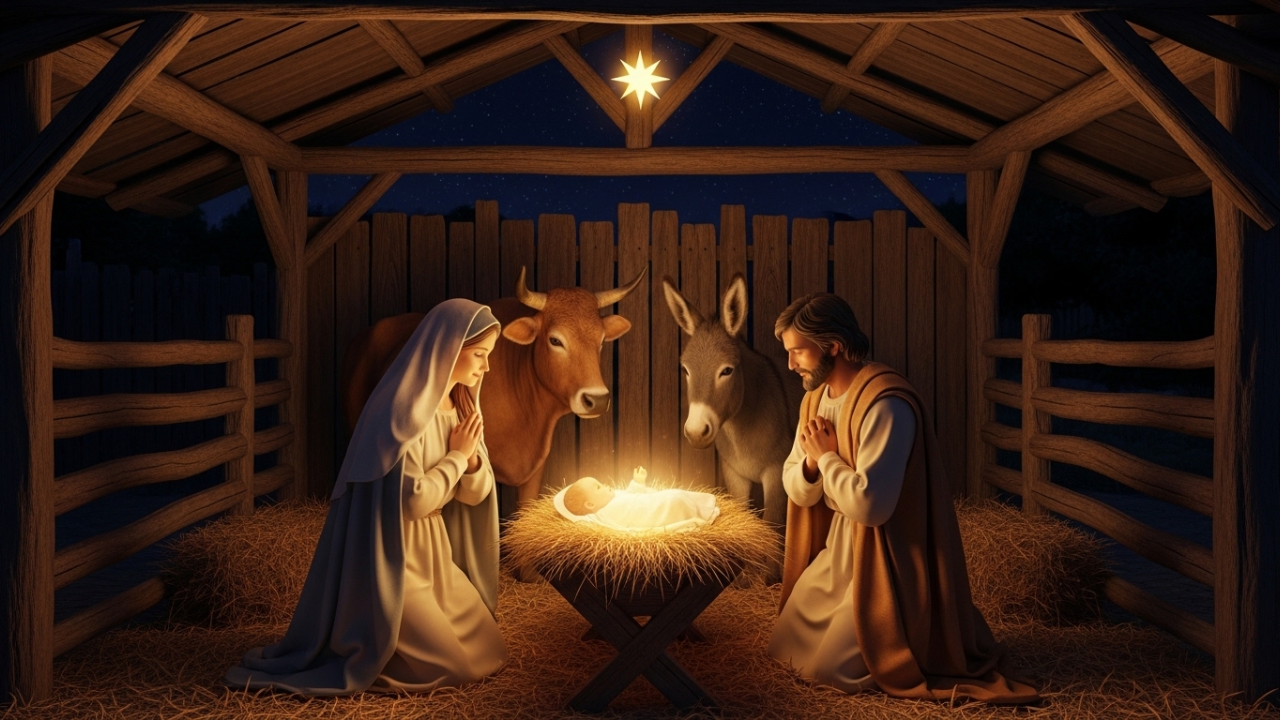
The Humble Stable: The setting itself—a modest shelter for animals—underscores the theme of humility. The King of Kings is born not in a palace, but in a place of straw and shadow, turning worldly expectations upside down.
-
The Divine Light: Artists often use a radiant glow emanating from the infant Jesus to represent his divine nature, a brilliant light entering the darkness of the world. This “Light of the World” is a recurring visual metaphor in Nativity paintings and hymns.
-
The Silent Witnesses: The ox and donkey, absent from the Gospel accounts but present in the apocryphal texts and beloved by tradition, have become essential characters. They symbolize the natural world and all of creation kneeling in submission to its Creator.
The Wider Influence: From History to the ‘Nativity Style’
The term Nativität extended its influence even beyond religion and art, leaving its mark on law and history. The phrase Nativitätsstil (Nativity style) refers to a specific medieval method of dating historical documents.
Similarly, in demographic statistics from the early 20th century, the word Nativität was used as a synonym for the birth rate or fertility rate of a population. These obscure historical and bureaucratic uses demonstrate how widely the concept of ‘birth’ and its associated term permeated European thought for centuries.
Nativität Today: Why the Old Story Still Matters
In our modern, often secular world, you might wonder why a term like Nativität still holds any relevance. The answer lies in the universal themes it represents. While it is a cornerstone of the Christian faith, the underlying idea of a new beginning is something everyone can understand.
Each Christmas season, when families set up their crib or attend a midnight service, they are participating in a tradition that stretches back nearly 800 years. But beyond the tradition, the story offers a powerful message that transcends any single religion. It is a story about:
-
Hope in the midst of winter’s darkness and the challenges of life.
-
Humility, reminding us that true value is not found in material wealth or status.
-
Renewal, the idea that every dawn, every year, and every new start carries the potential for something wonderful.
You don’t have to be a believer to appreciate the beauty of a peaceful Nativity scene, the sound of a choir singing “Stille Nacht,” or the feeling of gathering with loved ones to celebrate the promise of a fresh start. This is the true power of the concept: it is a story that has continued to speak to the human heart for two millennia because it touches on the fundamental experiences of love, family, and new life.
A Final Invitation
As you continue through this holiday season, take a moment to look deeper at the traditions around you. Whether it’s a centuries-old wooden carving in your local church or a small porcelain figure in your own home, each depiction of the Nativität is more than just a decoration.
It is a visual prayer for peace and a symbol of hope that has survived wars, plagues, and the relentless march of time. It connects you to countless generations who have pondered the same mystery: that the most profound changes in our world often begin in the quietest and most unexpected places.
What does the Nativity mean to you?
We’d love to hear your thoughts and stories. Share your most cherished Nativity memory or tradition in the comments below, and let’s keep this beautiful conversation alive.