
Introduction: The Heart of Your Shower Experience
When you step into your shower, you expect a consistent, comfortable stream of water at your preferred temperature. The component that makes this possible—and prevents unpleasant surprises—is hidden behind your wall: the shower valve. Often overlooked during bathroom renovations, this critical piece of plumbing is the true command center of your shower, responsible for blending hot and cold water, managing pressure, and directing flow.
Choosing the right valve is about more than just convenience; it’s a decision that affects your safety, water efficiency, and long-term satisfaction with your bathroom. This guide will demystify shower valves, helping you understand the different types, key selection factors, and maintenance essentials for a shower that performs flawlessly for years to come.
Understanding Shower Valve Basics
At its core, a shower valve is a mixing device. It connects to your home’s hot and cold water supply lines, blends them to achieve the desired temperature, and controls the volume of water sent to your showerhead or tub spout.
A typical valve system consists of several key components:
-
Rough-In Valve Body: The main housing installed inside the wall that contains the mixing mechanism.
-
Cartridge: The internal part (often ceramic, thermostatic, or pressure-balancing) that does the precise work of mixing and controlling water.
-
Connection Ports: The inlets where your home’s plumbing pipes connect to the valve.
-
Trim Kit: The visible, decorative faceplate, handle(s), and escutcheon you interact with daily.
It’s crucial to distinguish the valve from the trim. The valve is the functional engine inside the wall, while the trim is the stylish interface you see and touch. They must be compatible, typically from the same manufacturer, to work correctly.
The Main Types of Shower Valves Explained
There are three primary valve technologies, each suited for different needs and budgets. Understanding their differences is the first step to making the right choice.
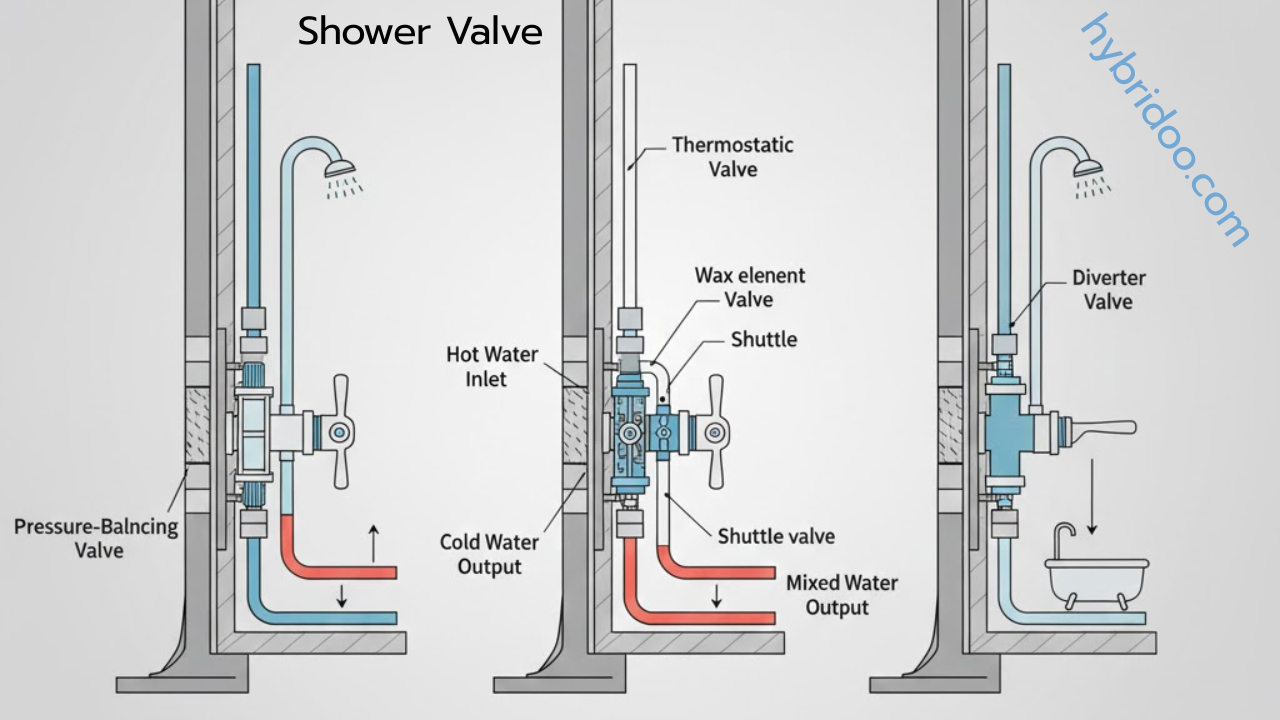
1. Pressure-Balancing Valves (The Standard Protector)
This is the most common type in modern homes and is often required by plumbing code. Its primary job is safety.
-
How It Works: It contains a piston or spool that reacts to changes in water pressure. If someone flushes a toilet and cold water pressure drops suddenly, the valve instantly reduces the hot water flow proportionally to prevent a scalding surge.
-
Best For: Standard single-head showers or tub/shower combos. It’s a practical, cost-effective choice that provides essential anti-scald protection.
-
Limitation: Most models use a single handle to control both temperature and flow, so you lose your temperature setting when you turn the water off.
2. Thermostatic Valves (The Precision Controller)
This valve type offers superior control and is the preferred choice for luxury or multi-outlet showers.
-
How It Works: It uses a thermostatic element (often wax) that expands or contracts with temperature changes to maintain your pre-set water temperature with high accuracy, often within one degree. It typically features separate controls for temperature and volume.
-
Best For: Showers with multiple outlets (rain head, handheld, body sprays), households with varying temperature preferences, or anyone who values exact, repeatable settings.
-
Consideration: It is generally more expensive than a pressure-balancing valve and may have minimum water pressure requirements.
3. Diverter Valves (The Traffic Director)
A diverter does not mix temperature. Its sole function is to redirect water flow between different shower outlets. It is always installed in addition to a main pressure-balancing or thermostatic valve.
-
Types:
-
Two-Way Diverter: Toggles water between two outputs (e.g., a fixed showerhead and a handheld).
-
Three-Way Diverter: Can send water to either outlet independently or to both simultaneously.
-
Tub Diverter: The simplest type, often a pull-up knob on the tub spout that redirects water to the showerhead.
-
The table below summarizes the key differences to help you compare at a glance:
| Feature | Pressure-Balancing Valve | Thermostatic Valve | Diverter Valve |
|---|---|---|---|
| Primary Function | Prevents scalding from pressure changes | Maintains precise, pre-set temperature | Routes water to different outlets |
| Temperature Control | Adjusts with pressure changes | Independent, precise dial | No temperature control |
| Flow Control | Often combined with temperature | Separate volume control | Switches flow between fixtures |
| Ideal For | Standard showers, code compliance | Luxury showers, multi-outlet systems | Showers with 2+ showerheads or sprays |
| Relative Cost | $ | $$ | $ (as an add-on) |
How to Choose the Right Shower Valve
Selecting a valve involves more than just picking a type. Consider these critical factors:
-
Assess Your Shower Configuration: The number of outlets is the biggest determinant. A simple showerhead needs only a pressure-balancing valve. Add a handheld sprayer, and you’ll need a valve with a two-way diverter or a separate diverter valve. For three or more outlets (e.g., rain head, body jets, handheld), a thermostatic valve with a multi-port diverter or transfer valve is necessary to handle the higher flow demand.
-
Check Your Plumbing Compatibility: Valves have specific connection types. You need to know if your home uses Copper (soldered), IPS (threaded), or PEX (crimp or clamp) piping. The valve’s connection must match, or you’ll need the correct adapters.
-
Prioritize Safety and Comfort: If your household includes children, elderly members, or individuals sensitive to temperature swings, the precise control of a thermostatic valve is a significant safety and comfort upgrade.
-
Consider Material and Quality: The valve body should be made of durable, corrosion-resistant metal. Brass is the industry standard for its longevity and reliability. Avoid plastic-bodied valves for critical, behind-the-wall components.
-
Think Long-Term (Rough-In Flexibility): If you’re remodeling, consider a universal rough-in valve like the Hansgrohe iBox Universal. These allow you to change the trim style or even switch between pressure-balancing and thermostatic cartridges in the future without opening the wall again.
Maintenance, Repair, and Knowing When to Call a Pro
Even the best valves require occasional attention. Common signs of trouble include:
-
Inconsistent water temperature.
-
Low water pressure from the showerhead.
-
A dripping showerhead after the valve is turned off.
-
Difficulty turning the handle or a handle that feels loose.
Often, these issues can be resolved by replacing the cartridge, the valve’s wearable internal part. This is a common DIY repair for handy homeowners: shut off the water, remove the handle and trim, extract the old cartridge, lubricate and insert the new one, and reassemble.
However, know when to call a licensed plumber. Seek professional help if:
-
You discover a leak behind the wall.
-
The valve or cartridge is severely corroded or stuck.
-
You need to replace the entire rough-in valve body, which involves soldering or re-piping inside the wall.
-
You are unsure about compatibility or the repair process.
A professional installation ensures your valve functions correctly, meets local codes, and doesn’t create hidden leaks that can lead to mold or structural damage.
Conclusion: Investing in Comfort and Control
Your shower valve is a long-term investment in the daily comfort, safety, and efficiency of your home. While it remains out of sight, its performance is felt every single day.
By understanding the distinct roles of pressure-balancing, thermostatic, and diverter valves, you can move beyond guesswork. Match the valve to your specific shower setup, prioritize quality materials, and don’t hesitate to consult with a plumbing professional for complex installations. The right choice guarantees that your shower will provide a perfect, reliable, and safe experience for years to come.
Ready to transform your shower experience? Start by assessing your current setup or consulting with a plumbing expert to discuss the ideal valve solution for your next renovation or repair project.