
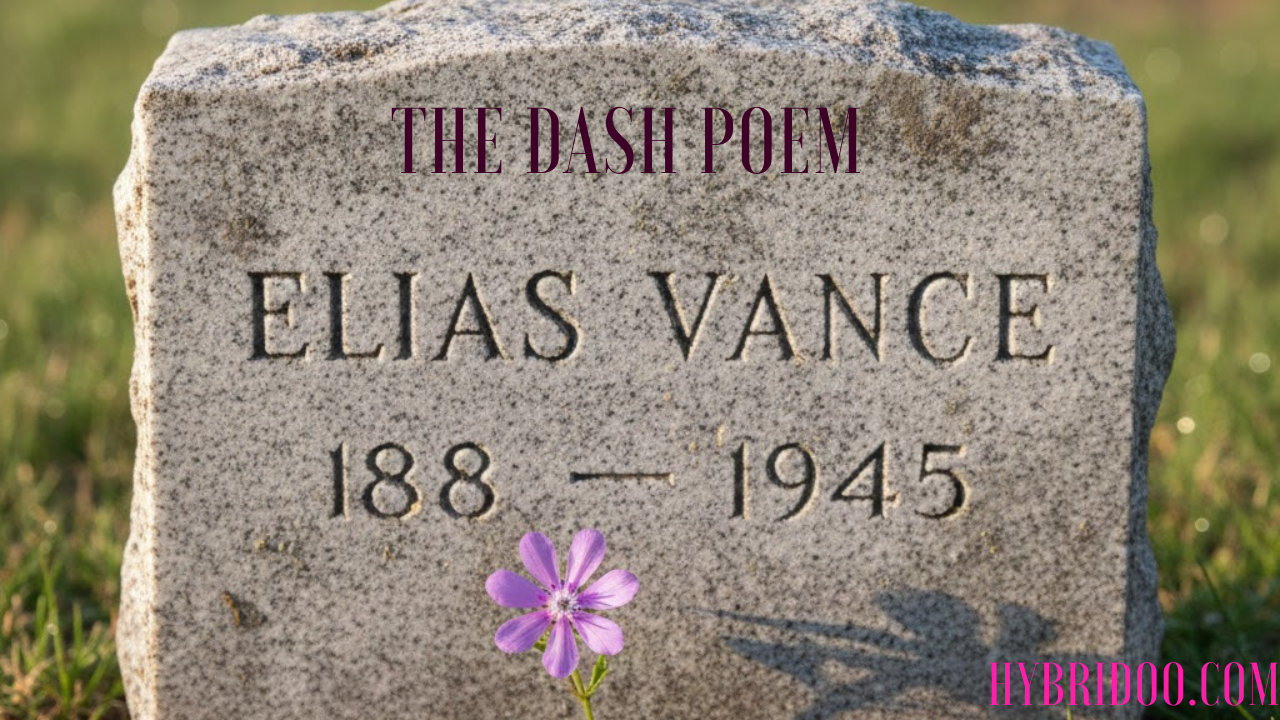
Introduction: The Little Dash That Means Everything
Have you ever stood in a quiet cemetery, reading the inscriptions on weathered headstones? You see a name, a birth date, a date of death, and between them—a small, unassuming dash. This simple punctuation mark, often overlooked, carries the entire weight of a human life. Linda Ellis’s The Dash Poem seizes upon this profound symbol, transforming it from a grammatical convenience into a powerful metaphor for how we live. Since its publication in 1996, this simple yet profound piece has touched millions, becoming a staple at funerals, graduations, and motivational gatherings. But what is it about this poem that resonates so deeply? This article explores the origins, meaning, and enduring impact of The Dash Poem, and how its central message can inspire us to live more intentionally.
What is “The Dash Poem”? Origin and Summary
The Dash Poem was written by American poet and speaker Linda Ellis in 1996. The story goes that Ellis was moved to write after hearing a sermon that referenced the dash on a tombstone. She penned the poem in a single, inspired sitting, and after sharing it with a close friend, it began its incredible journey around the world via photocopies and, eventually, email forwards—a true viral sensation of the pre-social media era.
The poem’s narrative is straightforward. The speaker describes attending the funeral of a friend. While listening to the eulogy, they notice the dates on the tombstone: the year of birth and the year of death, separated by a dash. The poem’s central thesis is presented clearly: what matters most is not the dates themselves, but how we spent our “dash”—that small line representing all the years we lived and breathed.
Ellis uses the dash as a lens to examine a life well-lived. She asks rhetorical questions about how we spend our time: Do we treat others with love and respect? Do we prioritize what truly matters? The dash becomes a measure of our legacy, not in material possessions, but in relationships, kindness, and positive impact. The poem concludes with an urgent plea to the reader to consider their own dash, to slow down and appreciate life, and to ensure that when their own dash is being considered, it will be a story worth telling.
Deconstructing the Meaning: The Deeper Message Behind the Dash
At its core, the meaning of The Dash Poem is a call to mindfulness and purposeful living. It’s a memento mori—a reminder of our mortality—not to incite fear, but to provoke positive action. The dash symbolizes the present moment, the only part of the timeline we can actively influence.
Here are the key themes that give The Dash Poem its universal power:
-
Legacy Over Chronology: Our culture obsesses over milestones—birthdays, achievements, retirement dates. The poem refocuses our attention from the “when” to the “how.” Your legacy isn’t the date you retired; it’s the mentorship you offered, the integrity you showed, and the culture you built.
-
Relationships as Wealth: The poem implicitly values love and human connection above all else. “How we treat others” is directly highlighted as a primary measure of our dash. It suggests that repaired relationships, expressed gratitude, and shared laughter are the true currency of a meaningful life.
-
Mindful Presence: The line “If we could just slow down enough to consider what’s true and real” is a direct appeal against the autopilot of busy modern life. The dash is lived in the small, daily choices—the decision to listen, to help, to appreciate a sunset.
-
The Universality of the Human Experience: Regardless of faith, nationality, or background, everyone has a dash. This shared symbol creates a common ground, making the poem’s message accessible and relevant to a global audience.
The Cultural Impact: Why This Poem Endures
The Dash Poem has transcended its form to become a cultural phenomenon. Its impact is evident in several areas:
-
Funerals and Memorials: It is perhaps most frequently read at end-of-life services. Its non-denominational, uplifting message offers comfort and focus, helping mourners celebrate the essence of the departed rather than just mourning their passing.
-
Motivational Speaking and Corporate Settings: Speakers and leaders use the dash concept to inspire teams toward values-driven work, ethical decision-making, and a positive workplace culture. It reframes success beyond quarterly profits.
-
Personal Development: For individuals, the poem serves as a touchstone for annual reflection, goal-setting, and course-correction. It answers the question, “What am I working toward?” with a focus on character and contribution.
-
Adaptations and Media: The poem’s popularity has spawned books (including Linda Ellis’s own Live Your Dash), songs, artwork, and jewelry—tangible reminders people wear or display to keep the message close.
Its endurance lies in its elegant simplicity. It doesn’t prescribe a specific religion or philosophy. Instead, it provides a flexible, powerful framework that each person can fill with their own values and aspirations.
Living Your Dash: Practical Ways to Apply the Poem’s Message
Understanding The Dash Poem is one thing; living it is another. Here are actionable steps to ensure your dash is rich with meaning and purpose.
1. Conduct a “Dash Audit.”
Periodically, perhaps on a birthday or at the New Year, pause and reflect. Ask yourself Linda Ellis’s questions:
-
Am I living a life I’m proud of?
-
How are my most important relationships?
-
Do my daily activities align with my core values?
-
What do I want people to remember about me?
2. Prioritize Relationships.
-
Mend: Have you left something important unsaid? Is there a relationship that needs repair? Take the first step.
-
Deepen: Invest quality, device-free time in your family and friends. Listen actively.
-
Express: Don’t assume people know you love or appreciate them. Tell them. Write the note. Make the call.
3. Define Success on Your Own Terms.
Resist the societal pressure that defines success by salary, title, or possessions. Write your own definition. Is success a peaceful home? A body of creative work? A community you’ve strengthened? Let your dash be guided by your values.
4. Embrace Contribution.
A meaningful dash often extends beyond oneself. Find ways to contribute:
-
Mentor someone in your field.
-
Volunteer for a cause you care about.
-
Practice small, daily acts of kindness.
5. Practice Mindful Presence.
Your dash is composed of present moments. Cultivate presence by:
-
Practicing gratitude (keeping a journal can help).
-
Reducing distractions to be fully engaged in conversations.
-
Finding joy in simple, everyday experiences.
The Dash in the Digital Age: A Modern Reflection
In an era defined by digital footprints—our social media profiles, our online achievements—the metaphor of the dash becomes even more poignant. Our online “dashes” can be curated, filtered, and exaggerated. The poem reminds us that the true record of our lives isn’t the highlight reel on Instagram, but the offline moments of integrity, struggle, compassion, and love that rarely get posted. It challenges us to ensure our real-life dash is more impressive, authentic, and meaningful than our digital one.
Conclusion: Your Dash is Being Lived Right Now
Linda Ellis’s The Dash Poem endures because it speaks a fundamental truth in an accessible way. It reminds us that the story of our life is still being written in the space between our significant dates. The two dates on the tombstone are given to us; the dash is what we make it.
The power—and the urgency—lies in the fact that we are all currently living out our dash. This isn’t a message for someday; it’s a message for today. Every choice, every interaction, every moment of courage or kindness is adding a stroke to the legacy of your dash.
Your Call to Action: Pause and Reflect
Take a literal moment right now. Think about the dash that will represent you. What do you want it to mean? Then, make one small, immediate commitment. Perhaps it’s calling a parent, forgiving an old grudge, signing up to volunteer, or simply deciding to be more present at dinner tonight.